

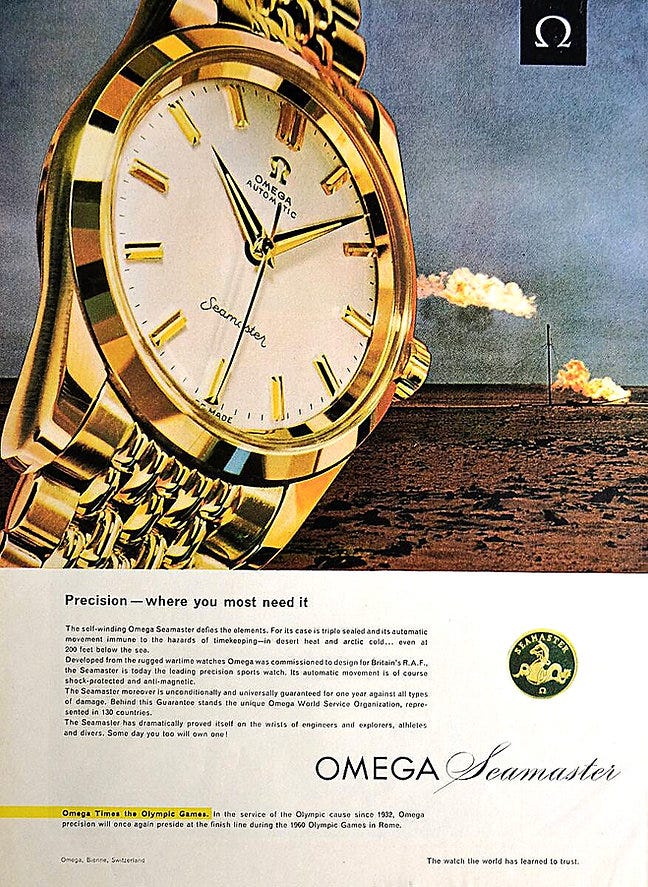
For much of the twentieth century, accuracy was the way a Swiss watchmaker could prove its watches were better. They were the most accurate.
Brands competed over it, measured it, entered movements into observatory competitions to prove it. And advertised it.
Then, on Christmas Day 1969, Seiko launched the Quartz Astron. It was around 100 times more accurate than a mechanical watch.
That was a problem for Swiss watchmakers. They could spend years developing a better mechanical movement, use better materials, employ more skilled watchmakers and improve their manufacturing.
But they were never going to beat quartz at telling the time.
And if accuracy was what customers valued most, it was a big problem.
Blancpain chose a different competition
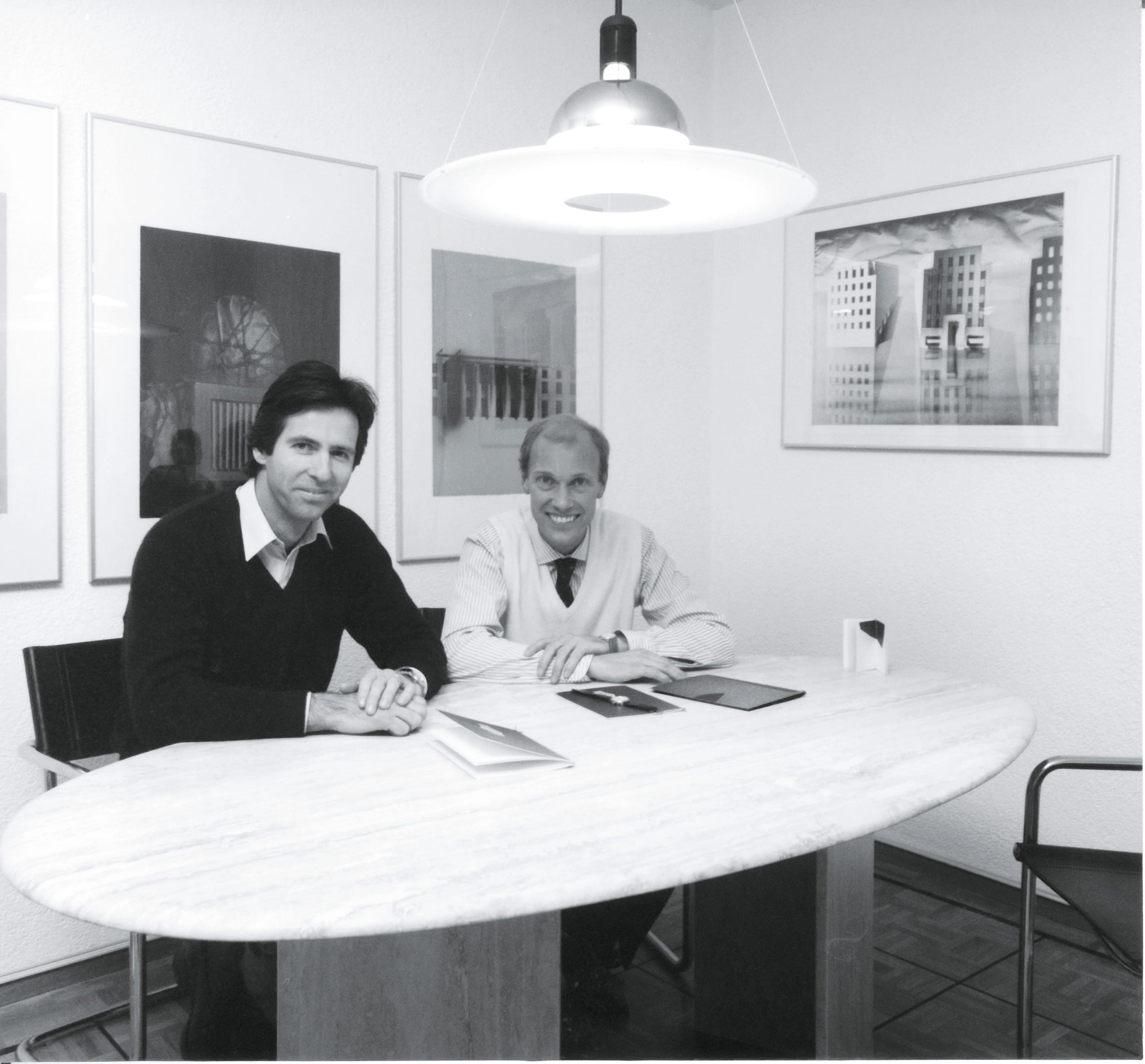
In 1981, Jean-Claude Biver and Jacques Piguet acquired the rights to Blancpain, a historic (founded in 1735) but, at the time, dormant Swiss watch brand, for around CHF 22,000.
An extraordinary time to bet on mechanical watches.
The Swiss watch industry was being devastated by quartz. Since the beginning of the Quartz Crisis employment had fallen from about 90,000 to 45,885. Entire companies were closing down.
Mechanical watches looked like outdated technology.
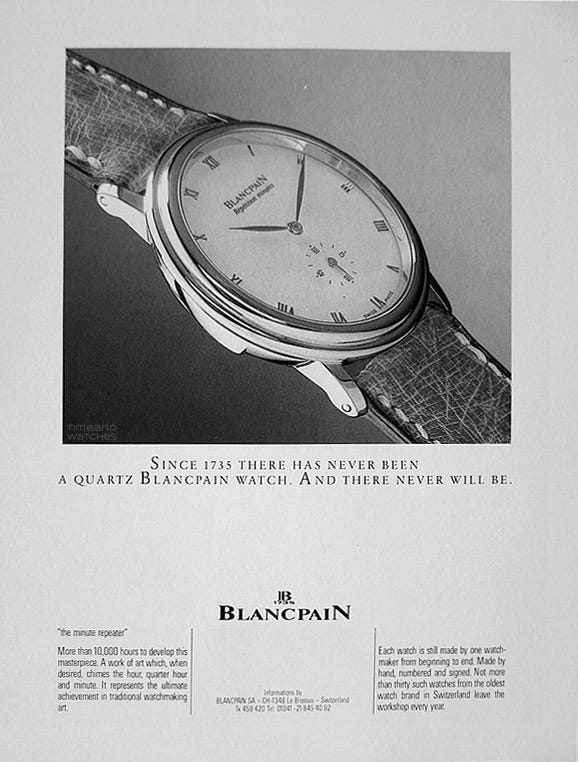
Biver and Piguet could have tried to make Blancpain more competitive by launching a quartz watch. They didn’t.
Instead, they made being mechanical part of the reason to want one.
Blancpain’s advertising famously declared:
“Since 1735 there has never been a quartz Blancpain watch. And there never will be.”
Think about what they were doing. Quartz was more accurate. So Blancpain made accuracy less important.
Instead, it asked customers to value craftsmanship. Mechanical complexity. Tradition. Human skill. Heritage. The pleasure of owning something made in a way that was increasingly unnecessary.
The very thing that made a mechanical watch technologically obsolete became what made it desirable.
Blancpain still made excellent watches. Quality was still important.
But quality wasn’t the whole proposition.
Eleven years later, Blancpain was sold for CHF 60 million.
Coffee has its own version of this problem
Specialty coffee has spent years getting better.
Better green coffee. Better roasting. Better grinders. Better espresso machines. Better water. Better extraction. Better training.
And that’s been enormously good for coffee.
It’s been good for everyone. Including your competitors. More and more of them can access the same things you can.
A great espresso machine is available to anyone who can afford it. So is a great grinder. Exceptional green coffee is more widely available. Knowledge that once belonged to a relatively small group of specialists can now be learned online. Talented baristas move between businesses. And, in the age of Instagram, the aesthetic of a specialty coffee shop can be copied very quickly.
So what happens when everybody has a great machine, a great grinder and really good coffee?
Those things stop being enough to make you different.

Being better isn’t the same as being different
Biver didn’t decide that quality no longer mattered. He recognised that quality alone couldn’t win the competition he was in.
Of course your coffee needs to be excellent. But if the café down the road also serves excellent coffee, telling customers yours is excellent doesn’t give them a compelling reason to choose you.
You need to create other reasons for them to care.
Maybe that’s the producers you choose to work with and why. Maybe it’s an uncompromising approach to sourcing. Maybe it’s your relationship with a particular community. Maybe it’s a distinctive point of view about roasting. Maybe it’s hospitality. Maybe it’s the reason you opened the business in the first place.
The answer will be different for every business.
That’s the point.

Find something your competitors can’t buy
You can buy a La Marzocco. Your competitor can buy one too. You can buy an exceptional grinder. So can they. You can source an outstanding coffee. So can they.
Those things matter enormously. But they’re becoming the price of entry, not a guarantee of differentiation.
What is much harder to buy is a distinctive reason for people to care about your business.
That’s where story, identity, relationships, beliefs and point of view become valuable.
And you don’t need Blancpain’s marketing budget to communicate them.
They’re already being communicated through your menu, your packaging, your website, your Instagram, your café and, most importantly, the conversations your team has with customers every day.
The difficult part isn’t finding somewhere to tell your story. It’s figuring out what story is actually worth telling.

What are you making valuable?
Blancpain couldn’t control the fact that quartz was more accurate. It could control what Blancpain stood for.
So instead of spending its energy trying to win on the attribute where its competitors were stronger, it gave customers entirely different reasons to value its watches.
Coffee operators should be asking themselves the same question.
If great coffee and great equipment are increasingly available to everyone, what are you giving people that they can’t get from the café down the road?